Wednesday, July 20, 2011
Los Angeles.

Tuesday, April 5, 2011
Wrapping Project : Part 1.


Illustrator Rendering.
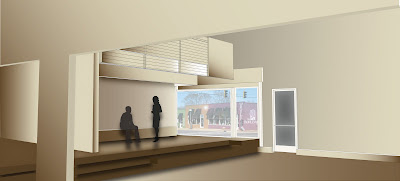
Using the same wireframe, we had to render the space using illustrator. I preferred this one over the photoshop rendering simply because I could easily manipulate the space and go crazy with gradients and the shadow tools.
Photoshop Rendering.

As a class, we were given a wireframe and it was up to us to render it, using photoshop, in any way we'd like. This was one of my first tries with photoshop...I loved it and have learned so much from it.
Wednesday, January 12, 2011
New Semester. New Year. New Outlooks.

So, over the past few years, I've become an addict of the Avett Brothers. And today, this particular lyric has been on my mind all day. I'm determined to let this outlook be my motivation throughout this semester. I'm typically worried about other peoples work and how my work doesn't even compare to theirs. But I shouldn't. I should be letting who I am come across in the work that I put out. I guess you could call this my new year resolution. New semester, new year, new outlook.
Friday, December 10, 2010
Point:Explorations.
A prominent theme in this class, for me, has been evolution. Everything has been a building block for the next style to come. Whether the era is rejecting the past or accepting it wholeheartedly, it’s forever present. One thing that I didn’t necessarily realize right off the bat is that it can go as far back as time will tell. For instance, the College Life Insurance Building has ties to the pyramids of the Egyptians, in both stature and roughly the idea behind it.
That’s another thing that this unit opened my eyes to. Post-modern buildings began to represent what they were building for. Like the TWA terminal, as well as other airports, resembling flight. I was actually driving down to Anderson, S.C. yesterday and realized that this isn’t just obvious in class, but it’s everywhere. I saw a Michelin Tires Company Building that was structured to resemble tire treads. This class has really taught me to open my eyes, and I truly appreciate that.
As well as representing what the building was used for, buildings were building on the past by using past building techniques; in design and in construction. The hotels began adopting the atrium style, which is obviously taken from Pompeii and places like the House of Vettii. But then you have the Church of the Light, which is an abstraction of the churches of the medieval times, in that the light creates the religious experience and the intensity of it. Then, there are things such as New Baris by Fathy, which takes ancient building practices and literally makes bricks from sand to construct the buildings. The past is a constant present in our everyday lives; we just have to take the time to notice it.
I’ve decided to take this post into a new direction and instead of talking mainly about the unit; I want to talk about the class as a whole. It’s a time of reflection for me. The last class was a time of communication and open thoughts and although I didn’t say anything, I just took everything in. I was thinking the whole time that I have been to Europe, yes, and I have seen some of the buildings, yes. It was cool to be in class and learn about them post-fact. But now, I just can’t wait to get back into the world and experience them again. Being in the class, as well as an Interior Architecture major in general, makes me have such a thirst for travel and experience of what is truly out there. As Patrick did say, ‘Looking at the world requires you to be in it.’ I can’t wait to go out into the world, and just like the Michelin Building yesterday, put my knowledge of the class on a larger scale. Thank you.
I chose this image, of a typical face collage, to show that everything now is parts of a whole. There are always tiny pieces to the bigger picture. You just have to look deeper to find it, and you will.


Friday, December 3, 2010
Reading Comprehension 7.

The other work of art I looked at was Fernand Leger‘s “Les Constucteurs“. This is a color lithograph, which I believe further represents the twist the art and architecture can have on work and commerce. As Roth states, “many contemporary expressions of modernism…reflect regional desires and needs…they respond to divergent theories on the role of architecture, coupled with the emerging changing in how buildings are conceived and designed.” [pg 612] This piece was different from the rest; yet spoke the same kind of language, which continues to be a challenge for contemporary design. Just as both of these pieces changed the concept of art to some and impacted the collection in a different light, so did minimalism. “Function, efficiency, and practicality no longer solely define concepts, so designs are often innovative, individualistic, monumental, and stand out within their environments.” [Harwood pg 806]