Thursday, September 1, 2011
Essay: How Light Can Affect Health
The power of light is something that few may consider during their lives. The changing of light has the ability to affect our mood due to increases and decreases of melatonin in your skin which you would think you would have the peak melatonin in the summer, but in fact it increases in darkness and promotes sleep. Another thing you may not realize is that light actually has an effect on your metabolism, heart rate patterns, and many other physical body functions. These things may be overlooked, unless of course you have a disorder like SAD (Seasonal Affective Disorder), which is caused by inadequate exposure to the sun. Inadequate sun exposure also leads to a weaker immune system and could provoke diabetes and many other bodily dysfunctions. Coming from me, a person who has not really heard of these sun related disorders, before reading these articles, I had no idea that the human body could be affected so drastically by the changing of light. It is so intriguing to see that sunlight affects more than just emotion. It affects your bodily rhythm, as well as how you function on a day-to-day basis. Also, it is interesting to see that something as simple as ‘Daylight Savings Time’ could have so many negative effects on the body. It is similar to jet lag. You sort of have to make yourself adjust to it or else you will have consequences. Although there are some ways to trick your body into adjusting, there are some things that can only be helped by bringing in artificial light, avoiding the sun, or making yourself more available to the outside world.

Essay: Light Revealing Experience
The bond between a place and humanity branches from experience. When you enter a space, the way the light is cast has the potential to change your mood, bring you back to an earlier time, or even give you a false feeling of warmth or coldness. Light also varies from place to place. It is dependent on geographical area, climate, the surrounding nature, and time of day, etcetera. For instance, if you live in the southern part of the states you will notice that there are often bigger windows allowing more light in, which in turn gives you the feeling of warmth and comfort. In the readings it states that in industrialized areas, it is harder to experience the wonders of natural lighting. I have never thought of that because I grew up in a suburb of Charlotte, so when I went to the city, I was drawn to the more scenic areas rather than all of the skyscrapers. But when I began thinking about it, it is true. When tall buildings on a regular basis surround you, it seems as if he only sunlight you are getting is through the glass in a high rise. It is more difficult to see the sunrise and sunset because the buildings break up the flow of sunlight and you mainly see shadows compared the sunbeams. My theory is that is why you can tell a distinct difference in office spaces versus homes, or dining places. Lighting is affected due to the trade it is being designed for. When you are in an office, you are used to constantly having artificial light around you and you are not getting a lot of natural light or fresh air for that matter. So when you walk into a place with that sense of lighting, you are aware that is what is being conveyed. However, when you enter a restaurant, it is meant to give you, the customer, the comfortable feeling of home, so the lights are dim, it is a comfortable atmosphere, which makes you feel comfortable eating, drinking, and being social.
The way light is diffused is also a psychological mind game. Designers try to mimic things in nature by using a wide range of materials and structural pieces, which can create different effects that also evoke a variety of emotions, using natural and artificial lighting. Architects can manipulate a space by adding screens, stained glass, etc to make an area reminiscent of a forest in Finland or the sunset in New Mexico. The simple tricks, like using brick and wood to stimulate warmth, are the things that bring us mental and sensual pleasure without trying. It is something that make us feel welcome and at home. Whether you prefer the warmer side of design or the cooler side of design, lighting can change it all. For instance, if the area has plentiful shade and cooler colors, it is seen as a chilly room. Which to some, fits right in with them and brings them psychological relief.
Though it may be obvious, the change of seasons has a dramatic effect on lighting and the way it is portrayed. In North Carolina, especially, the bright summer sun is, or so it seems, hotter, higher, and the light is a little bit hazier. It is so humid especially in this area of the United States that when I began to think about it, it made perfect sense. Also, I realized that the reason I probably do not like the winter months, besides the obvious fact of it being cold, is that the light out tends to be more gray and a little bit more dreary compared to summer, or even spring and fall. The light being affected by the time of year is a concept that when you think about it, it makes perfect sense, it is just like an extended view of the daily changes you witness from dawn to dusk. Light can also be transformed by ornamentation. In harsher climates, as the reading showed, you can add a touch of gold to an existing gray backdrop and it adds the sense of comfort that you did not have before.
After reading this article, it has opened my eyes to the reactions we subconsciously have to lighting and the manipulation of lighting. It is very interesting to realize that what you may think is as simple as lighting is actually a little more complex than you think, it has the ability to change your mood, your perception, and even your feel of a space.
Wednesday, July 20, 2011
Los Angeles.
I haven't blogged in awhile, but I started creeping on blogs of friends, peers, and professors and decided I'm going to pick it back up. Also, I'm going to start doing a collage notebook of every day events. Maybe I'll even start today. Stay posted...
Tuesday, April 5, 2011
Wrapping Project : Part 1.


This is part one of the 'Wrapping' project. The first image is the model made of 400 wooden blocks. We were instructed to build a model that represented a numerical pattern. I chose the Butterfly Effect and specifically how Historical American Events (from 1960-today) affects the music of the decade, and how the music derived from historical events affects drug use.
The next step of the project was to 'wrap' the project in any way you see fit. I chose to use different colored string to emulate the Butterfly Effect and how one strand can affect another part of the project.
After wrapping the model, we were instructed to have a flat pattern representing the wrapping itself. I chose to take photos in plan view and trace over the lines and patterns that the string created to come up with the various patterns you see above.
Illustrator Rendering.
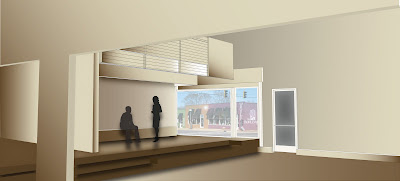
Using the same wireframe, we had to render the space using illustrator. I preferred this one over the photoshop rendering simply because I could easily manipulate the space and go crazy with gradients and the shadow tools.
Photoshop Rendering.

As a class, we were given a wireframe and it was up to us to render it, using photoshop, in any way we'd like. This was one of my first tries with photoshop...I loved it and have learned so much from it.
Wednesday, January 12, 2011
New Semester. New Year. New Outlooks.

So, over the past few years, I've become an addict of the Avett Brothers. And today, this particular lyric has been on my mind all day. I'm determined to let this outlook be my motivation throughout this semester. I'm typically worried about other peoples work and how my work doesn't even compare to theirs. But I shouldn't. I should be letting who I am come across in the work that I put out. I guess you could call this my new year resolution. New semester, new year, new outlook.
Subscribe to:
Posts (Atom)